

Anger is the key to understanding the nature of the tragedy that is The Iliad, and the moral landscape of Homeric Greece. The opening lines of the poem ask the goddess to sing of the anger of Achilles, “which put pains thousandfold upon the Achaians”. However, because we have come to see anger as having a negative moral connotation, we can easily miss its purpose in this story. Here we will analyze books I and II because they set the tone for the rest of The Iliad.
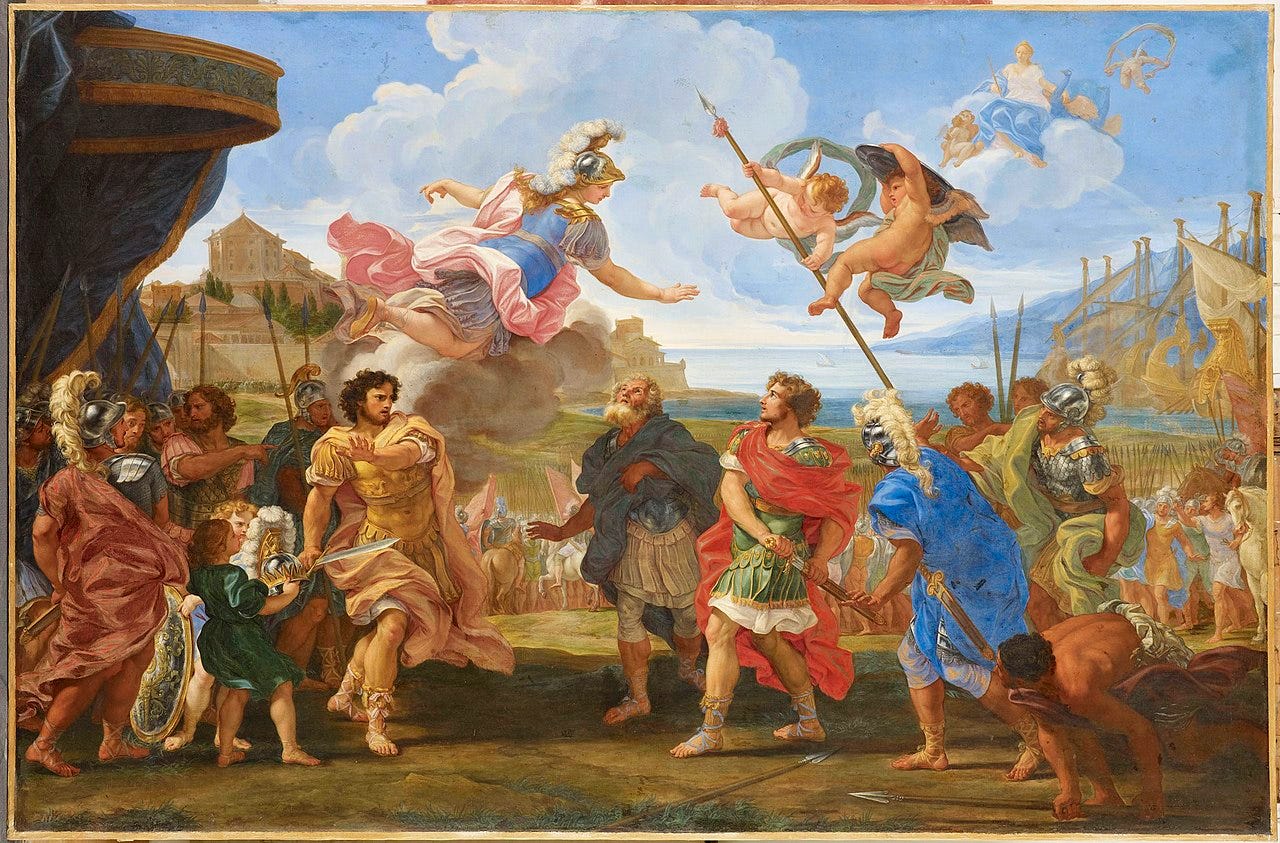
A Short Synopsis of Books I and II
The poem begins in the tenth year of the Trojan war, at which point the Greeks are tired and battle weary, having reached a brutal stalemate with Troy. Agamemnon publicly refuses a ransom from a priest of Apollo for the return of his daughter, which he has taken as a war prize. Apollo afflicts the Greeks with a plague as retribution, and Achilles calls an assembly of the Greek kings to ascertain the cause of Apollo’s anger with them. When it is revealed that the cause is Agamemnon’s refusal to return the priest’s daughter, Agamemnon is willing to return her, but not without taking away the war prize of another Greek king to compensate him for the loss. Achilles is angered by this, and the two have a falling out that results in Agamemnon taking from Achilles the woman who had been awarded to him as a war prize. Achilles responds by publicly refusing to acknowledge Agamemnon’s authority as legitimate, withdrawing himself and his forces from the war, and entreating the gods to favor the Trojans instead.
Book two exposes what happens when the Greek unity is fractured, while the gods further exacerbate a deteriorating situation. Zeus seeks to deceive Agamemnon by sending a dream in which he tells him that his victory over Troy is imminent. Agamemnon then decides to test the resolve of the remaining Greek forces by suggesting that he has given up on the conflict and that they should return home. The men are eager to leave, and begin immediately returning to their ships. However, their leaders are ultimately able to marshal them for combat again, and they make sacrifices to the gods in preparation for battle.
Power, Honor, and Anger in Context
What unfolds in book I of The Iliad is a tightly linked chain of events that cause anger in Apollo, Agamemnon, and Achilles setting the tragedy in motion. This is probably the primary point of confusion for a modern reader, including myself when I had first read this in high school. Having grown up in a Western culture that still retained the vestiges of a guilt culture’s moral framework, it’s hard not to see these characters as morally ambiguous at best, or morally bad at worst. They don’t fit neatly into the dichotomous moral economy of good and evil we use to portray modern fictional characters. However, all of these characters are morally coherent in their own time and framework.
The difference between a shame–honor culture and a guilt culture is complex and much debated, and I will address it more fully in a separate post. For our purposes here, however, I’ll offer a simple working distinction. In a shame–honor culture, moral judgment is primarily external. A person’s standing is determined by how they are publicly perceived, recognized, or exposed. To be revealed as weak, dishonorable, or contemptible before others is itself a moral failure. By contrast, a guilt culture locates moral judgment internally. What matters most is not how one appears, but whether one has done what is right or wrong, even if no one else knows. In such a framework, a person may retain public respect while still bearing moral guilt, whereas in a shame–honor culture, public exposure is often the decisive moral verdict. At the time of Homer, Greece was more or less a shame-honor culture.
With this framework we can see that Agamemnon’s mistake is not refusing the ransom or declining to return Chryses’ daughter, but publicly dishonoring Apollo’s priest. He treats Chryses as a lesser man whose appeal can be dismissed because he lacks power, failing to recognize that Chryses speaks as an emissary of divine authority. Apollo, who is more powerful than Agamemnon, responds to this violation by afflicting the Greeks with a plague, restoring right order through a demonstration of that power. The irony is that this response compels Achilles—a lesser king than Agamemnon—to call an assembly that exposes Agamemnon’s failure, forcing Agamemnon to confront a mirror image of his own offense wherein his authority is publicly challenged by those beneath him.
Achilles’ actions are morally intelligible within this framework because they expose a genuine failure of leadership on Agamemnon’s part, which rightly calls his legitimacy into question before the other Greek kings. Achilles’ speech suggests that this offense is not isolated, but emblematic of a broader pattern of abuse and misrule observed over the course of the war. Yet Agamemnon, unable to absorb public loss of honor, responds not by restoring legitimacy, but by asserting his power to publicly dishonor Achilles instead. In this light, Achilles’ anger is not itself the moral failure, but rather the signal of one. The failure lies in the breakdown and abuse of rightful authority that gives rise to the anger, even as that anger contributes to the larger tragedy that follows.
Hierarchy Divorced from Legitimacy Breeds Chaos
Book II reveals what happens once hierarchy is severed from legitimacy. At the request of Achilles’ mother Thetis, Zeus sends Agamemnon a deceptive dream promising imminent victory. This act exposes a tension over divine authority among the gods, that mirrors a growing leadership crisis among the Greeks. Zeus’s decision is met with resistance from Hera, requiring further intervention from Athena to contain the fallout. Authority remains intact, but harmony does not. Order is no longer naturally present, and must be actively managed.
The same pattern is repeated among the Greeks where the actions of the gods are exacerbating this growing disorder. Aware that his leadership no longer commands genuine allegiance, Agamemnon attempts to test, and ultimately manipulate, the Greek forces through deception. The result is near collapse, as the men rush for the ships eager to abandon the war, and order is restored only through public coercion and shame when Odysseus publicly beats Thersites to silence his dissent. The Greek coalition still exists, but it no longer coheres.
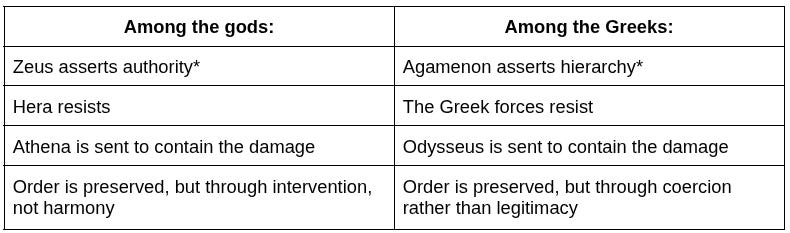
*In this context, “authority” refers to power that is recognized as legitimate, while “hierarchy” refers to power enforced by rank or position, even when legitimacy is in doubt.
Logs for the Fire
What we are left with by the end of Book II of The Iliad is a frayed Greek alliance, in which order is preserved through force in the absence of legitimacy. The Greeks of Homer’s day were by no means democratic, but that does not mean they were indifferent to legitimacy within their hierarchies of authority. When legitimacy falters, power does not disappear, but its application becomes more dangerous.
As modern readers, we should ask ourselves what kind of world emerges when power becomes the primary means of sustaining the order we have come to expect. When you consider the institutions and social structures that govern your towns, cities, states, and nations, do you sense their legitimacy to be secure, or waning? And if it is waning, what are the long-term costs of maintaining order without it?