

Western civilization’s foundational story is not about virtue, progress, or enlightenment. Homer’s Iliad is about power, honor, and the slow recognition that these things are not enough.
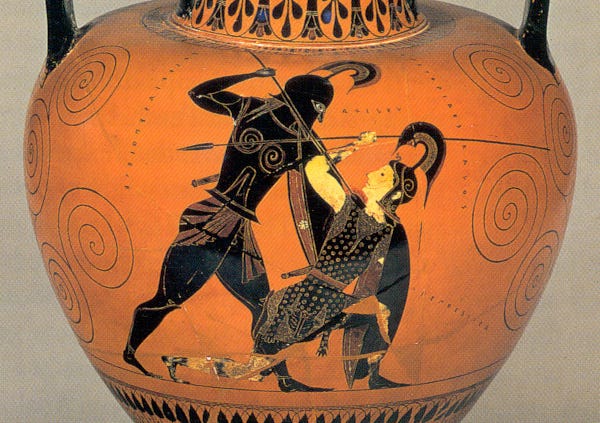
Homer’s Iliad and Odyssey stand alongside the biblical corpus as the beginning of Western civilization’s consciousness, making them an excellent place to begin reflecting on its present condition. This is the aim of the Ark Project: to revisit the texts and ideas that formed Western civilization to spur discussion about how we could forge a better future. The Iliad became the basis for later commentaries on the dangers of unrestrained power in the works of Herodotus and Thucydides, the ethical critique of anger from the Stoics to Aquinas, and the insight that legitimate leadership requires justice, restraint, and reverence for higher order.
Contents
What Kind of Story the Iliad Is (and Isn’t)
The Iliad is a poem that tells the listener how the heroic age ended for the Greeks, akin to the great flood in Genesis and the antediluvian period that preceded it. Most of the major heroes are doomed and Greek listeners at the time of Homer knew it, which is part of the emotional atmosphere of the story as a tragedy. The emotional weight of the Iliad isn’t built through suspense, but the inevitability of a destiny already known to the audience. This presumption of cultural knowledge, which we now lack, is a primary reason why modern readers will struggle to understand the poem.
Equally important to understanding the Iliad is the moral landscape of Homer’s time. Though later Greeks such as Sophocles and Aeschylus would reinterpret these stories through a deeper moral lens and the still later Judeo-Christian lens would reveal how the nature of sin sealed the fate of many, the Greeks of the time did not see it this way. Their culture was not one of guilt, nor did they subscribe to a moral understanding of human behavior like their Jewish counterparts in the promised land.1 Rather, the Greeks of Homer’s time saw this story as a revelation of an awesome, but ultimately unsustainable heroic age. The Greek gods are not moral authorities, and the human characters are not moral exemplars. The story certainly reveals a moral landscape, but one that only later-developed moral frameworks could properly interpret.
Greek culture at this time was an honor culture, and the story highlights what honor demands. The gods are active in the world, and are responsible for the events that unfold, including those which the story treats as causal to the tragedy. They are just as petty as humans, with vendettas, grudges, and quarrels, which dramatically impact the lives of mere mortals who are powerless against them. In fact, the author of the story seems to externalize non-rational experience as the result of divine influence.2 In essence, the Iliad is descriptive rather than prescriptive.
The Iliad, in Brief: Honor, Wrath, and Tragedy
The heart of this story is laid bare immediately as the opening lines take us to the tenth year of the Trojan War. The Achaeans are a confederation of kingdoms drawn into war with Troy (a city on the coast of modern day Turkey) to avenge the honor of Agamemnon’s brother, Menelaus, whose wife Helen was abducted (or seduced) by the disgraced Trojan prince Paris. The Greek kings had previously sworn an oath for the right to court Helen in her youth: they would defend the chosen husband, should their marriage be violated, as a means of avoiding war amongst themselves. Agamemnon’s brother Menelaus ultimately wins Helen’s hand in marriage. Thus, when Paris later carries Helen off to Troy while Menalaus is away, the conditions of the oath are triggered, and the Achaeans unite under the leadership of Agamemnon.
What ensues in book I is an incredible irony, considering the reason the Greeks are at war with the Trojans in the first place. Agamemnon has taken Chryseis, the daughter of a priest of Apollo named Chryses, as a war prize. When Chryses offers Agamemnon a rich ransom for her return, Agamemnon refuses. In response to this affront, Chryses prays to Apollo for justice. Apollo answers his prayer by causing a great plague to afflict the Greeks. As the plague threatens to turn the tide of the war, Achilles calls an assembly of the Greek kings and recommends withdrawing from the conflict if they cannot appease the gods to end the plague. When it is revealed by a seer that Agamemnon’s refusal to return Chryseis is the cause, Achilles advises returning the girl, which results in a heated dispute between the two kings wherein Achilles questions Agamemnon’s conduct and honor while openly insulting him.
The wise, and very old Greek king Nestor attempts to counsel the two against their quarrel, as it is bad for the whole of the Greek alliance, but is unsuccessful. Agamemnon, though willing to return Chryseis, will not suffer the loss of honor without stripping Achilles of his own war prize, a woman named Briseis. This deeply wounds Achilles’ pride, and drives him in anger to withdraw his men from the conflict, while entreating his divine mother Thetis to appeal to Zeus to bring about great misfortune for the Greeks in their war with Troy.
Achilles’ wish is ultimately granted and the Greeks are unable to gain advantage against Troy. Eventually, it is revealed that Achilles is fated to die if he returns to the battlefield, but will have glory that lives well beyond his days on earth. Alternatively, he could have a long life of insignificance by abandoning the war permanently and returning home. However, it is the loss of his dear friend Patroclus in battle that ultimately moves Achilles to return to the war. He eventually defeats the heir-apparent to the throne of Troy, prince Hector, and desecrates his body.
The story ends with Hector’s father, King Priam entering Achilles’ camp to beg him to return his son’s body so he can be given a proper burial. Achilles is brought to further grief, thinking on how his own father will fare after he learns of his (Achilles) death, and agrees to return Hector’s body. Thus the story begins and ends with a parent asking for the return of their child. Achilles at last avoids the mistake that has brought the Greeks to ruin in the first place by recognizing their shared humanity rather than denying Hector (and Priam) the dignity of a proper funeral, and treating honor as absolute in conduct, though Achilles is still doomed to die.
A Cultural Memory of a Collapsed Civilization
In reality, this story is something of a cultural memory for the Greeks. This war, if indeed historical, is one that likely transpired towards the end of the Bronze Age.3 The Bronze Age concluded with a civilizational collapse for Greeks. There are many theories as to why this occurred, which include a prolonged drought, a serious plague, external pressures such as war or predation from piracy, and/or internal strife.4 Regardless of cause, there was a dramatic reduction in Greek trade and a dwindling supply of tin, which made forging bronze items such as weapons and armor a rare commodity. Economies likely collapsed as well, and many once great Greek palaces from this time period appear to have been burned from within, suggesting potential social upheaval or civil conflict. By some estimates, the population throughout the Greek mainland may have fallen by as much as fifty percent.5
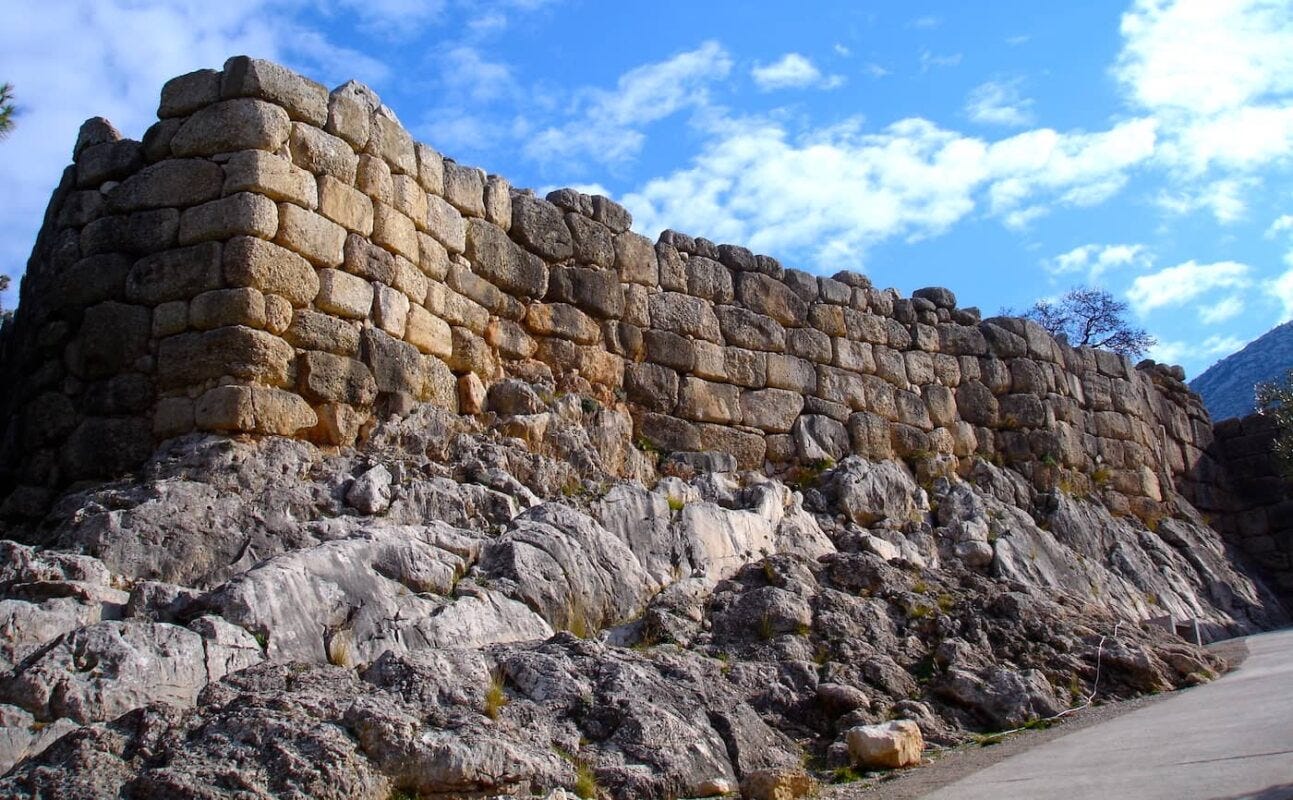
Indeed, Greeks of Homer’s time would’ve looked back at the once great Greek palaces of the bronze age, which still stood unoccupied in their time, as a testament to a mythical age long since passed; one where they could barely conceive of how these structures were even made. For example, the famed “Cyclopean Walls” were so named because Greeks after the Bronze Age collapse believed they were built by cyclopes due to their large and seemingly perfect nature. Thus the Iliad can be understood as a literary post-collapse consciousness of a grander Greek past, which seeks to explain their present circumstances. Here the modern Western reader can find commonality with the Greeks from the time of Homer through a shared sense of cultural amnesia, if not post-abundance decline.
What the Iliad Reveals About the West Today
The Iliad is important to the Ark Project because it confronts us with a civilization approaching its own demise. Homer does not offer a vision of renewal, reform, or escape. He preserves a memory of what human life looks like when power outruns restraint, when honor becomes absolute, and when reconciliation is possible only through shared suffering. The poem is not intended to be instructive, but it can still be diagnostic. Modern Western readers should perceive a world defined by a morally ambiguous landscape; one that looks increasingly similar to our own. The question for the Ark Project, which will guide our analysis of the text in a subsequent post is: what does the Iliad teach us about the causes of civilizational decay, and what, if anything, could alter that course?
Recommended Reading and Works Consulted
To aid me in this inquiry, I have consulted the following works, which I recommend to readers who wish to deepen their understanding alongside me as we explore the Iliad together.
The Greeks and the Irrational
Dodds, E. R. The Greeks and the Irrational. Berkeley: University of California Press, 1951.
A foundational study of Greek moral and religious experience in the age of Homer, originally developed from lectures delivered at the University of California, Berkeley, in the 1940s. Dodds’ analysis is especially valuable for understanding Homeric psychology and the externalization of non-rational experience through divine agency.
The Greeks: A Global History
Beaton, Roderick. The Greeks: A Global History. New York: Basic Books, 2021.
A wide-ranging and accessible history of Greek civilization from its earliest periods to the present day. Beaton combines strong scholarship with a clear narrative, making this an excellent orienting work for readers new to Greek history.
The Iliad
Homer. The Iliad. Translated by Richmond Lattimore. Chicago: University of Chicago Press, 1951.
One of the most technically faithful English translations still readable for modern audiences. Lattimore preserves line numbering, making it especially useful for close reading and cross-reference.
The Iliad & The Odyssey
Homer. The Iliad & The Odyssey. Translated by Samuel Butler. New York: Barnes & Noble Classics, 1999.
A prose translation that prioritizes narrative clarity over poetic form. While less precise than modern verse translations, Butler’s English retains a certain dignity and clarity that some readers may find more accessible.
E. R. Dodds, The Greeks and the Irrational (Berkeley: University of California Press, 1951), 31-32.
Dodds, The Greeks and the Irrational, 1-18. This idea is the primary premise of the entire book, but is most succinctly stated in the opening chapter.
Roderick Beaton, The Greeks: A Global History (New York: Basic Books, 2021), 38-39.
Beaton, The Greeks, 32-34.
Beaton, The Greeks, 41-43.