

What happens when duty demands everything, but honor no longer guarantees meaning? In the previous post, we examined how anger in the Iliad transforms a broken situation into tragedy, and how authority, once severed from legitimacy, breeds disorder among the Greeks. That tragic tension is felt most clearly in the doomed fate of the poem’s heroes and in their responses to that fate. A comparison between the Greek and Trojan forces, and between the men who lead them, reveals civilizational insights that remain relevant to the modern reader. Nowhere is this more apparent than in the middle books of the poem, where the demands of duty and honor unfold within a morally complex narrative that refuses the simplicity of a tale of good versus evil.
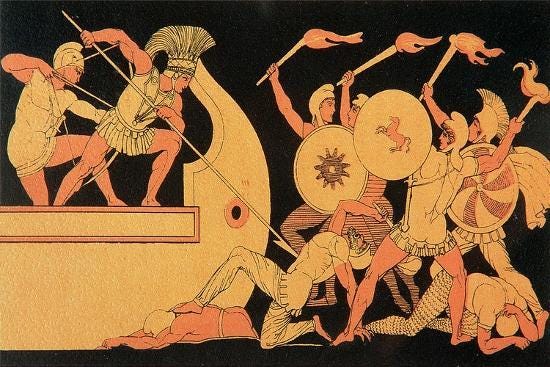
Synopsis of Books 6-9
In Books 6–9, the war presses forward under a faltering Greek alliance overshadowed by Achilles’ absence from the battlefield. Hector returns to Troy in Book 6, where his encounters with his mother Hecuba, his brother Paris, his wife Andromache, and his infant son reveal a city still ordered by family, duty, and reverence for the gods, even as Hector seems to acknowledge its imminent demise. Unlike Achilles, Hector chooses to fight on for the sake of what honor demands, even though he knows in his heart it will be to no effect.
The war briefly pauses in Book 7 with a duel between Hector and Ajax and a temporary truce between the Greeks and the Trojans to bury their dead, offering a fragile glimpse of the two sides recognizing their shared humanity before violence resumes. In Book 8, Zeus forbids the gods from interfering, tipping the balance decisively in Troy’s favor and driving the Greeks toward despair as they are pushed all the way back to their ships. By Book 9, Agamemnon attempts to mend the rupture by sending an embassy to offer Achilles an immense amount of wealth to restore him to the fight. However, Achilles rejects compensation, articulating a profound refusal of a system that has stripped honor of meaning and life of measure.
The Tragedy of Troy
The middle books of the Iliad sharply contrast the Greeks and the Trojans, as well as the heroes who represent them. While the Greek alliance has fractured under a loss of legitimacy within its leadership, Troy finds itself in a fundamentally different and more complicated position. The war is the direct result of Paris’s violation of the law of hospitality (Xenia - ξενία) when he carried off Helen along with wealth from Menelaus’s household during his host’s absence. Xenia is not simply a form of good manners, but rather a sacred obligation overseen by Zeus. For this reason, the Trojans recognize Paris’s wrongdoing, and the elder Antenor urges Helen be returned to the Greeks in book 7. Even the messenger sent to the Greeks admits that the Trojan people wish Paris would give her back.
“Son of Atreus, and you other great men of all the Achaeans, Priam and the rest of the haughty Trojans have bidden me give you, if this message be found to your pleasure and liking, the word of Paris, for whose sake this strife has arisen. All those possessions that Paris carried in his hollow ships to Troy, and I wish that he had perished before then, he is willing to give all back, and to add to these from his own goods. But the very wedded wife of glorious Menelaus he says that he will not give, though the Trojans would have him do it.” 1
Paris, however, is not the king of Troy; his father Priam holds that authority. Nor is Paris the heir to the throne; Hector is the heir apparent. Yet Priam never compels Paris to return Helen, and the Trojans do not question his leadership in this matter. Unlike the Greek situation at this stage of the war, Troy faces no crisis of political legitimacy.
What confronts us instead is a moral catastrophe that appears to be undoing an entire kingdom, though even this judgment is complicated. Aphrodite, a goddess, has given Helen to Paris as a reward for choosing her as the most beautiful among Hera and Athena. While this episode is not explicitly narrated in the Iliad, it was well known by the time the poem took shape. It helps explain the open hostility of Athena and Hera toward Troy, Helen’s pervasive self-loathing and diminished sense of agency, and Priam’s insistence in Book 3 that the gods themselves bear responsibility for the war. Troy’s tragedy, then, is not one of fractured authority, but of collective submission to an inherited moral catastrophe—a posture that stands in stark contrast to the unraveling ethos of the Greeks themselves.
The Declining Greek Ethos
The Greeks, by contrast, who began the war with clear moral justification rooted in the violated honor of Menelaus, are increasingly behaving in ways that strain the limits of a shame-honor culture. While such conduct might be attributed to the corrosive effects of a ten-year war eroding the formality of honor, this explanation falters when set alongside the poem’s formal duels, wherein Greek and Trojan champions alike observe the rituals of honor and part on respectful terms.
The erosion of Greek moral coherence becomes unmistakable in Book 6, when a Trojan is thrown from his chariot and begs Menelaus for mercy, offering ransom from his family in exchange for his life. Menelaus is prepared to honor the request until Agamemnon intervenes, urging him to kill the man and spare no one, not even the pregnant women of Troy. Nestor, in turn, reinforces this posture by instructing the Greek forces to take no prisoners.
By the end of Book 7, this erosion extends beyond the battlefield. The Greeks burn their dead on a funeral pyre, then heap a burial mound over them and use it as the foundation for a defensive wall against the Trojans. The wall is not even dedicated to Poseidon, provoking his anger. In building their fortifications directly atop the remains of their fallen, the Greeks blur the boundary between what is owed to the dead and what is expedient for the living, subordinating remembrance and honor to military necessity in a way that is, at best, morally problematic.
Hector and Achilles
The contrast between Hector and Achilles forms a less obvious but revealing lens through which Homer interrogates the moral economy of a shame-honor culture. Hector is, for the most part, a static character who consistently does what honor demands. He is the quintessential hero of this culture. In Book 6, his wife Andromache meets him as he prepares to leave the city and return to the battlefield. She is distraught, knowing that Hector cannot defeat Achilles, who had earlier killed her father and seven brothers during the sack of Cilicia. Hector’s response reveals precisely how a hero in this culture is expected to think and act:
“All these things are in my mind also, lady; yet I would feel deep shame before the Trojans, and the Trojan women with trailing garments, if like a coward I were to shrink aside from the fighting; and the spirit will not let me, since I have learned to be valiant and to fight always among the foremost ranks of the Trojans, winning for my own self great glory, and for my father.” 2
In Book 9, Achilles’ refusal of Agamemnon’s embassy and offer of immense wealth if he returns to the battlefield confronts the audience with the inverse of Hector’s position, rendering him almost alien within a shame-honor culture. Achilles initially withdraws from the war in anger, wishing destruction upon the Greeks. Yet having sat with that anger, he has now rationalized his position with an unsettling critique of the entire honor-prize system itself. Agamemnon’s actions, he argues, have rendered the system incoherent: no gift can be trusted if it can simply be taken away again at Agamemnon’s convenience. Achilles then presses the logic further, closing with the dilemma revealed to him by his divine mother, Thetis—that if he remains at Troy, he will die young with everlasting glory, but if he returns home, he will live a long life having lost that glory.
“For not worth the value of my life are all the possessions they fable were won for Ilion, that strong–founded citadel, in the old days when there was peace, before the coming of the sons of the Achaians… but a man's life cannot come back again, it cannot be lifted nor captured again by force, once it has crossed the teeth’s barrier.” 3
With this, he informs Odysseus and the rest of Agamemnon’s embassy that he intends to set sail at dawn the following morning, and that they should advise the rest of the Greeks to do the same. This renders the embassy speechless and brings his friend and surrogate father, Phoenix, to tears as he pleads with Achilles to reconsider. Yet Achilles remains unmoved. The true force of his refusal lies in the question it leaves hanging before all who hear it—what good are prizes and honor if they cannot be enjoyed or accompany a hero beyond the threshold of death, especially when that is the price so many heroes will pay in this war?
Logs for the Fire
Hector and Achilles stand in fundamentally different circumstances, just as the Trojans and Greeks occupy fundamentally different positions within the war. Hector fights to defend his home with a powerful enemy at the gates, bound by his duty to city and family. Achilles, by contrast, fights under the obligations imposed by the oath sworn by Helen’s suitors, an inherited and personally binding commitment that draws him into a war not of his own making. The Greeks thus possess a clear moral justification for the conflict, yet their conduct grows increasingly morally incoherent as the war drags on. The Trojans, by contrast, are ensnared in a morally compromised situation made more inescapable by divine intervention, yet continue forward under an authority they do not contest.
What unites Hector and Achilles is that both are honor-bound in circumstances that will ultimately lead to their demise. Their distinct responses to that fate reveal something essential about duty and honor, not merely as personal virtues, but as forces that shape—and sometimes consume—the civilizations they serve. This tension remains legible in the modern world, where men and women are still asked to risk their lives for ideals inherited from institutions whose legitimacy may no longer be secure, or whose moral ethos may be questionable. When that legitimacy or moral ethos erodes, what sustains the willingness to fight for goods like freedom, rather than retreat into the private enjoyment of whatever time remains? Leave your thoughts in the comments!
Homer, The Iliad, trans. Richmond Lattimore (Chicago: University of Chicago Press, 1951), 7, 385-393.
Homer, The Iliad, 6, 440-446.
Homer, The Iliad, 9, 400-409.